Seventy-eight percent of respondents to a LinkedIn poll told us that they struggle to create future-proofed strategies because they are simply too busy with the day-to-day. Frankly, this is not surprising. And this is how Sue Tiller and Lucy Howe from The Growth Factors, framed this webinar, and looked at why it is so important to plan for growth with resilient and future-focused strategies.
Why is it important to plan for growth when we have so much to do day-to-day?
A future proofed strategy helps you think with a growth mindset, giving your business and people clear direction of where the focus should be and why.
A SMARTER approach allows you to anticipate change and capitalise on opportunities and helps to ensure you will be best placed to grow.
Be SPECIFIC. Trends are not all equal! We believe there are 3 levels of trends that you need to consider.
Contextual trends – Global trends that are impacting shopper/consumer behaviour at a very macro level.
High Impact trends – trends that you must act on such as Health or Sustainability
Exploratory trends – those that you would consider acting on.
All of this should be done in relation to what matters most to your Shoppers and Consumers, your Customers and your Business’ commercial risks and opportunities – Sue Tiller explains below.
MEASURABLE and how ACTIONABLE a trend is in the context of your business.
Think of this as building a business case: Some will be no brainers with low risk and high return that you should just get on with, others will be higher risk and may or may not deliver a return. You need to model these and decide on the level of risk v the reward your business is willing to or needs to take.
Understanding the value of a trend for your business and brand helps you to prioritise your action plan into shorter- and longer-term strategies and break it down into bite sized chunks to deliver competitive advantage – Lucy Howe sets out the M & the A
RELEVANT. Be honest about what sort of business and brand you are – are you real innovators or followers? As well as distinguishing what’s right for different parts of the business? Not all trends are relevant for all parts of the same business or all brands in the same business.
You don’t all have to use all the framework just because it’s been built! Sue welcomes colleague Rosie Whiteford to give a fascinating example of how strategies need to be relevant.
TIMELY. We know that there are long-term trends vs fads. Utilising a fad might be a strategic push to win short-term and there’s nothing wrong with that if it is part of your strategy to jump on those fads and you are agile enough to do it BUT you must recognise that fads will likely come and go and this should be built into your sales plan, which may include it’s entrance and reduced growth and potential exit from the market.
This means you also need to balance a potential fad with trends that will give you more stable and long-term results, but trends can take time to build as it requires a change in consumer behaviour, and some are easier to grasp than others dependant on consumer barriers to purchase – Remember PRIME – this is a perfect example of a fad, as Lucy explains…
Go beyond the predictable and obvious to have a strategy that is more EFFECTIVE than your competitors.
Think outside the box when looking for the insight resources behind your strategy – there is a false economy in just being inward looking, using the resources you’ve always used. Drive your curiosity and think about other sources of stimulation that may give you a different perspective. Unless you look for the new, you’ll end up doing what you’ve always done.
Consider the value of bringing in outside resource, focused expertise that is not caught up in the day to day and has the capability of stretching your thinking through constructive challenge, probing, prodding, questioning, pushing of boundaries to get you to a better place
It’s very hard to have a SMART strategy if you are working in isolation.Being cross functionally collaborative and having buy in from top to bottomhelps ensure your strategy is moreRESILIENT to future challenges and changethan competitors.
There is power in a collective, cross-functional working approach. Ensures sharing and learning from each other’s knowledge and experience is embedded behind the strategy and protects the strategy as inevitable people changes happen. It allows you and your strategy to be agile as well as resilient. Lucy welcomes Ian Garrett to discuss the ways in which he develops resilient strategies.
The SMARTER action plan is available to download and will help you make your strategies future-proofed and resilient.
This webinar is one of 3 in a series that helps leaders future-proof their organisations. Check out the others on our resources page.
Uspire LIVE: Future-proof your business – event content and downloads
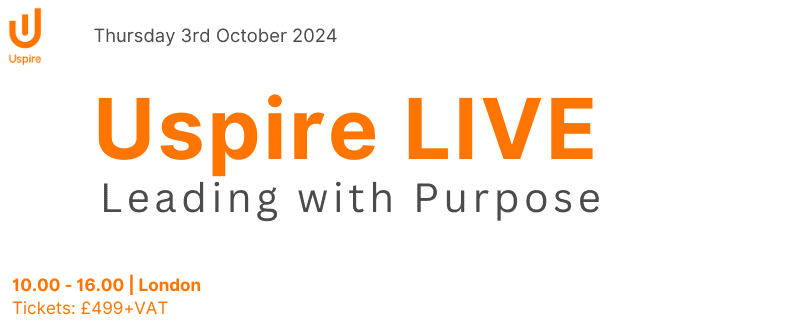
Leaders from a broad section of industries joined the Uspire team in Manchester on April 24th 2024 for Uspire LIVE: future-proof your growth.
Anticipating workplace trends improves business adaptability and fosters growth, and this is what we set out to debate with the help of David Smith, founder of Global Futures & Foresight, and one of the world’s leading futurologists and strategic thinkers. With David’s guidance and input, and our provocations to the room, our delegates worked as teams to debate how to:
outperform the competitor set by anticipating business trends and incorporating adaptations early;
implement foresight to accelerate business and people growth
empower people to adapt to change and remain competitive
predict future skills and capabilities
motivate multi-generational teams with an innovative mindset
We worked with David across 3 key provocations to develop views of the future that will help us embrace change with more certainty, reducing our risk of being blindsided by change, and improve our adaptability to a rapidly changing world.
Provoke, Energise, Transform @ Uspire LIVE
PROVOCATION 1: Tech: help or hindrance? The evolving landscape of work is driven by technological advancements, impacting identity, location, and tasks. David’s first provocation session looked at the role of technology in shaping work, workers, and workplaces.
Transitioning into the intelligent era from the digital era, technology is becoming smart, integrated, virtual, personalised, and predictive. Generative AI, is already reshaping tasks, whilst AR, XR, and VR offer new ways for workers, instructors, and leaders to interact creatively.
Connectivity is also advancing rapidly, with 5G and the promise of even faster 6G speeds, whilst the proliferation of low orbit satellites will revolutionise communication.
Automation, fueled by quantum computing and IoT, is pervasive, enhancing productivity from farms to industries. This shift brings about significant personalization and predictability, allowing us to tailor experiences not just for companies and individuals but also to anticipate future events and take proactive measures.
Watch David’s talk below.
PROVOCATION 2: Workforce of the future: attract & retain
David’s second provocation session debates the future of jobs and workforce dynamics. He highlights the emergence of new roles driven by technology, with a staggering 85% of future jobs not yet existing. London alone sees 10% of current roles being recent creations due to technological advancements. Roles like Chief Trust Officer and Extended Reality Designer are gaining importance.
The workforce is evolving with increasing diversity, influenced by migration and cultural shifts, with around 37% of Londoners being non-UK born. The pandemic accelerated change, leading to hybrid work models, and adaptation to these shifts is crucial as we anticipate further in the workplace landscape.
Watch David’s talk below.
PROVOCATION 3: Remaining Relevant
David’s third provocation looked at the critical notion of maintaining relevance in today’s dynamic landscape, essential for attracting talent and delivering value to clients.
The impact of digital disruption is evident, with many firms disappearing or transforming, including nearly half of the Fortune 500 companies. Successful organisations reinvent themselves continuously, reassessing propositions and values to align with evolving trends. Strategic missteps, accounting for 60% of organisational failures, underscore the importance of evolving and staying relevant.
This session evaluated not just workforce dynamics but also organisational strategies and offerings. Ultimately, the goal is to remain ahead of the curve, ensuring continued value delivery to all stakeholders in our ever-changing world.
Watch David’s talk below.
Provocations
Session1: Tech – help or hindrance
Session 2: Workforce of the Future
Session 3: Remaining Relevant
Highlights– Session 1
When new tech emerges nothing is ever the same again.
Ones who invested in their future by becoming thought-leaders are being replaced by AI.
AI will affect 40% of global jobs.
By 2030, AI & Ml (machine learning) will make humans more efficient.
Table debate: what is going to have the biggest impact on you & how, and what are you going to do about it.
Highlights – Session 2
Businesses need to be clever to recruit scare resource who understand how to work in this AI-enhanced way.
In 17 years only 1Bn of 6Bn workers will be in jobs we recognise.
Migration has led to huge shifts in cultural and economic references within one generation.
Businesses will need humans in three roles to support the new tech – trainers, maintainers, explainers.
It wont be outright job replacement, it is adaptation – the threat is retraining speed.
Table debate: discuss and capture the critical skills & characteristics you believe your workforce will need in the near future.
Highlights – Session 3
60% of public firm failure is due to strategic risk – what are we doing.
Digital modelling accounts for the disappearance of over half of the Fortune 500 since 2000.
Most businesses only change when the risk of doing nothing is more than the risk of doing something.
Organisations most future-prepared are 44% more likely to outperform their markets.
92% of CEO’s say organisational structures must change and 85% say internal obstacles impede company growth.
Table debate: choose one driver of change and, using the futures wheel, expand its implications.
Download our at-a-glance provocation summaries
We have taken the key points from each of David’s sessions and created these at-a-glance summaries for you to download
Continue your journey at our future-proof webinars
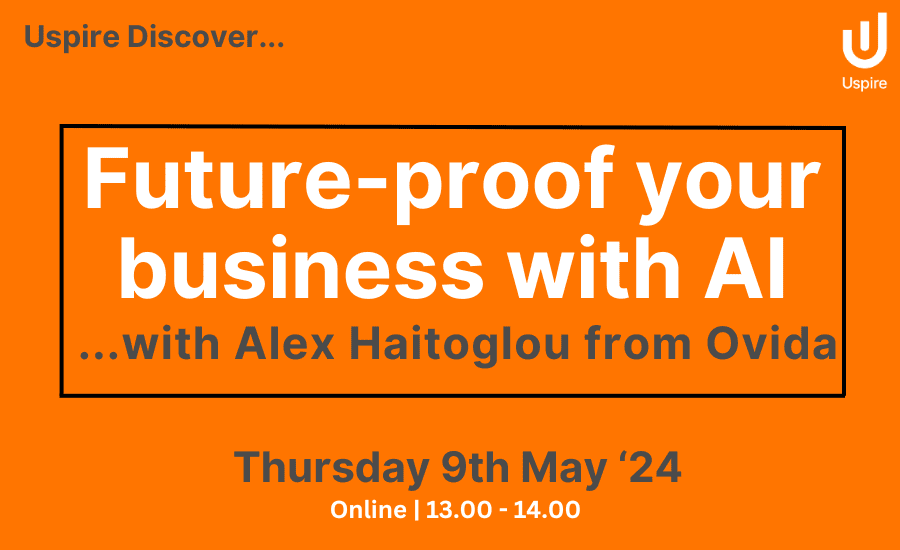
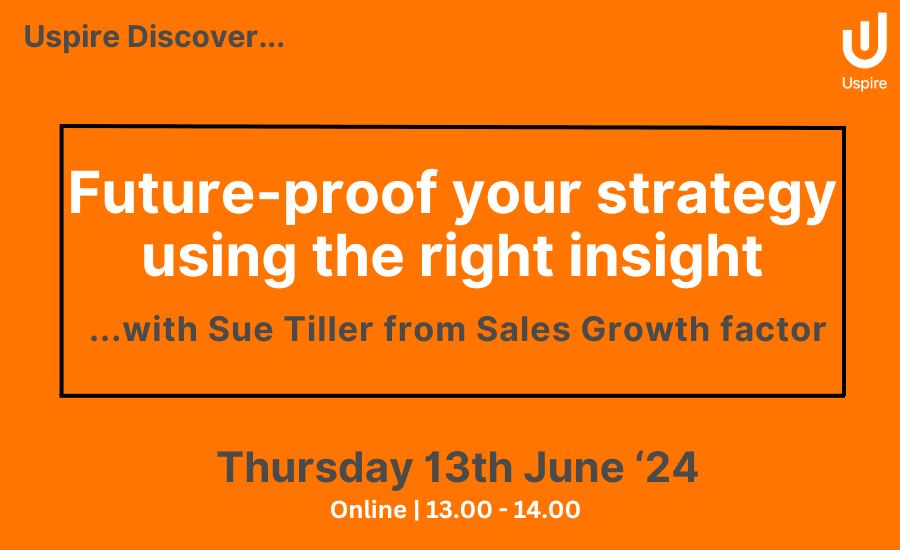
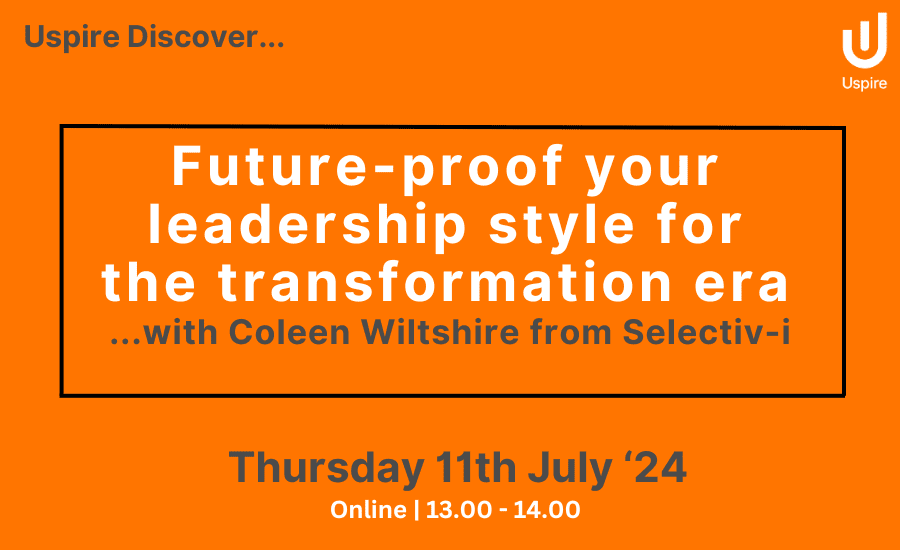
Introducing our ‘Future-Proof’ webinar series: Join us for one hour a month during May, June and July to explore essential strategies to thrive in today’s rapidly evolving landscape.
In the first session the extent of AI’s impact will be demystified and we’ll provide practical applications for your business. The second will help you harness data-driven insights to formulate effective strategies and the final session will enable you to adapt your leadership approach to navigate change successfully.
Future-proof with AI
We’ll discuss the “elephant in the room” – what is the impact for people? Which skills will – or won’t – be required in future. We’ll also define what is uniquely human, and understand how AI can help us become better at enhancing delivery of these aspects.
This session will guide you through the process of determining which trends you should use to formulate a future proofed strategy and the key sources of insight to inform you, brought to life with live industry examples.
Today, leadership hinges on the ability to influence people to see a vision for the future. We’ll explore the three recurrent leadership themes: managing remote teams; adapting to technological changes; and managing uncertainty and change.
What’s happening in the economy and why are current interest rates so brutal?
It has been quite a while since the Uspire Network issued an economic update and a lot of crucial questions are being asked by leaders.
In simple terms the economy includes all activities in the country concerned with the manufacturing, distribution and the use of goods and service-based enterprises. The economic climate has a big impact on businesses.
The level of consumer spending affects prices, investment decisions and the number of workers that businesses employ.
With our USPIRE overview the economic climate affects businesses in broadly ten ways:
Available labour pool
Changing levels of consumer income
Inflation
Interest rates
Tax rates
Exchange rates
Recession/GDP growth
Consumer confidence
Supply and demand
Changes in import legislation
These are generally managed by two strategies.
Fiscal policy is the government policy that impacts taxation and government spending. It can either be expansionary for growth and development with the aim of increasing economic activity by expanding Government spending and/or decreasing taxation.
Fiscal policy can also be contractionary, which aims to reduce economic activity by driving up taxation and/or reducing the amount of government spending.
Monetary policy involves changing the supply of money in an economy. This involves adjusting interest rates also manipulating exchange rates and controlling the money supply. The objective of monetary policy is to keep inflation rates stable and at a level to promote economic growth. In the UK, monetary policy and setting interest rates are the responsibility of The Bank of England.
What these do not factor in well is the behavioural changes in society no algorithm is available to accurately predict human behaviour. A great example is the unexpected way that the UK recovered from Covid, how consumers reacted post lockdown, all this happened much faster than any forecast.
18 months ago, we talked about the four horsemen of the business apocalypse.
These were: –
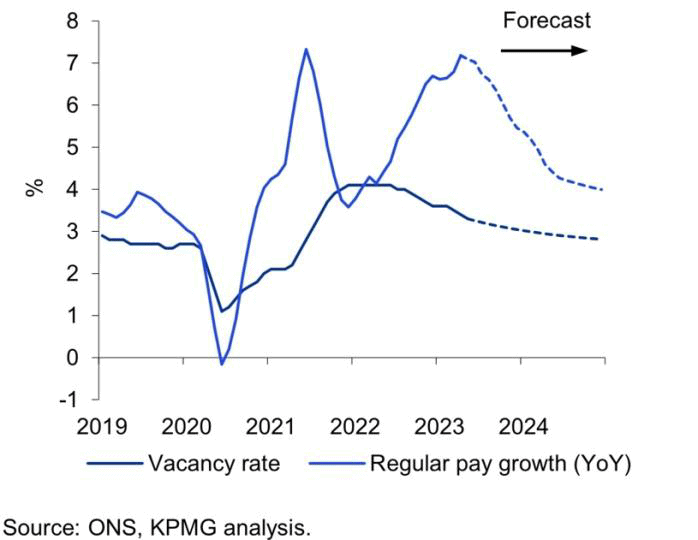
Labour shortages
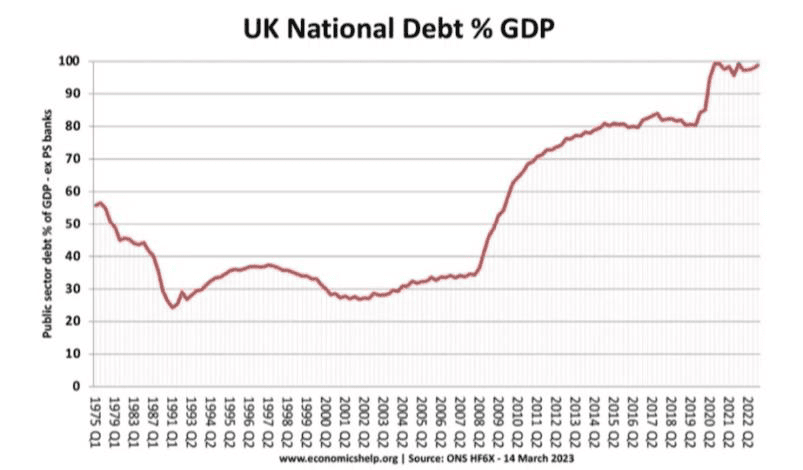
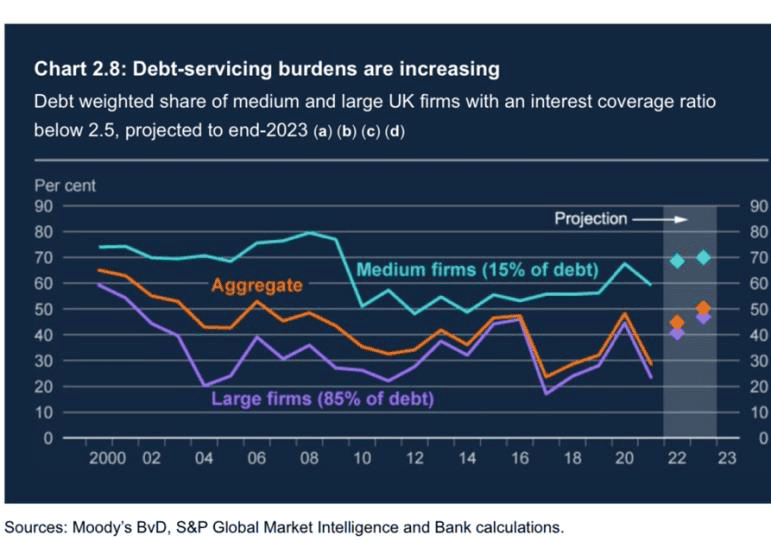
High Debt
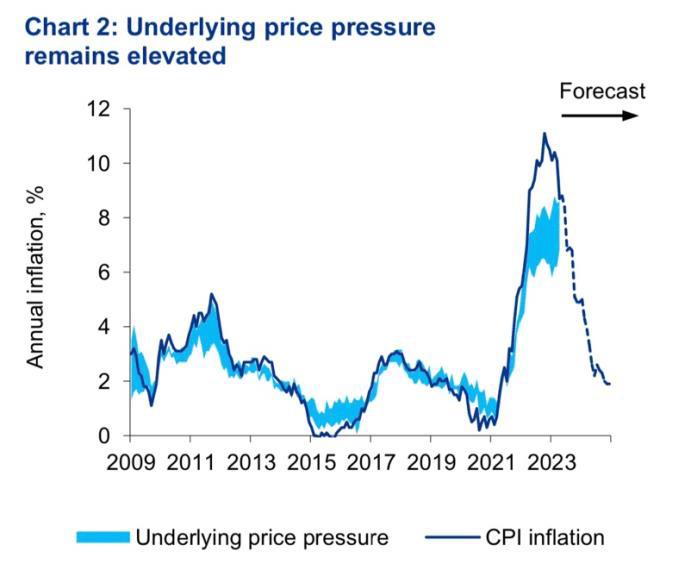
High Inflation/supply chain disruption
Consumer Uncertainty/Confidence
While the shape of these factors has changed, they are still very much playing havoc with our decision making.
In this blog we look at these factors by drawing relevant expert opinion and adding some of our own interpretation.
Let’s turn to the Bank of England’s own perspective on the UK and its economic challenges.
Why is inflation high?
High inflation has been caused by a series of big shocks to our economy.
The first shock was the Covid pandemic. While people had to stay at home, they started to buy more goods rather than services. But the people selling these goods have had problems getting enough of them to sell to customers. That led to higher prices, particularly for goods imported from abroad.
The second shock was Russia’s invasion of Ukraine, which led to large increases in the price of gas. It also pushed up the price of food. Poor harvests in other countries made the situation worse. Food prices in June were 17% higher than a year ago.
The third shock was a big fall in the number of people available to work. That was linked to the Covid pandemic. It’s meant that employers have had to offer higher wages to attract job applicants. Many businesses have had to increase their prices to cover those costs. That includes firms in the services sector, where wages are the largest part of business costs.
How does raising interest rates lower inflation?
People have asked the Bank of England why putting up UK interest rates will help. Some say it won’t tackle the causes of the inflation and it will only make the squeeze on household finances even worse.
Higher interest rates work by making it more expensive for people to borrow money to buy things. Higher interest rates also encourage people who can save to save rather than spend. Together, these things mean there will be less spending in the economy overall.
When people spend less on goods and services overall, the prices of those things tend to rise more slowly. Slower price rises mean a lower rate of inflation.
We know higher interest rates are hard for many people. But we must take this action to make sure inflation comes down and stays down.
Having high inflation for a long time would cause even greater hardship, especially for the least well-off and those in unsecure employment.
The action we take to keep inflation low and stable is called monetary policy.
Our Uspire Network opinion supported by narrative from the Henley Business School is as follows:-
When economic activity is high, i.e., companies can sell products and services in the desirable quantities without systematically decreasing their prices, companies are eager to expand production in order to profit from the customer willingness to spend. This “eagerness” leads to companies competing with other companies for the same resources (raw materials, talent, professional services etc).
Many companies are eager to “beat” competition for resources by paying higher prices, such as paying higher salaries or more for the same quantity of raw materials. That creates a domino effect in rising prices as, for instance, employees with higher salaries will spend more in their private life, competing, in turn, with other consumers for products or services that cannot increase in quantity or availability in the short run. Their consumption, then, leads to companies seeking further growth to capture the buoyant
demand for their offering. This flywheel effect in increasing prices is what maintains high inflation or, to reflect the widespread effect in the economy, a “high inflationary environment”.
This opinion of supply and demand factors was originally anchored in the days of people spending too much money on credit cards or borrowing money and spending excessively on luxury goods rather than essentials. Inflation during the past eighteen months is driven by different factors, Covid, Brexit and the war in Ukraine. During Covid there was a massive expansion in government debt, all of which was financed by the central bank. So Covid drove both expansionary fiscal and monetary policy. The expansion was $17 trillion globally, and $900 billion in the UK. The inevitable result is a surge in average price levels of everything i.e., land, buildings, labour, materials.
Brexit due to a focus on immigration reduced labour supply in the UK and complicated the import of goods from the EU, and of course this was compounded by the war in Ukraine. However, are we really spending to excess on fuel to heat homes or putting food on plates? The impact in the hospitality sector and retail would not suggest we have been spending to excess apart from the brief six-month period of demob enthusiasm and excitement of being released from lockdown.
The theory is that raising interest rates makes borrowing more expensive, encourages saving, discourages spending, reduces demand and therefore helps slow down price rises. However, we would argue that the UK still faces the prospect of dipping into recession now because of these unusual sources of inflation and it is not the time to be imposing measures that cool the economy down. The Bank of England have used interest rates as a blunt instrument a sledgehammer to crack a nut and not factored in changes in human behaviour driven by three unique events.
Mervyn King a man to respect had this to say recently about continually raising interests.
That the Bank of England could plunge the UK into a recession by raising rates too far, he said the signals from the credit markets in 2021 that indicated inflation was about to rocket were now showing that price growth was about to drop sharply.
King said officials on the monetary policy committee could tighten monetary policy too far if they pushed for further rate increases, triggering a recession.
He said the central bank had ignored signals from money supply data, which pointed to higher inflation coming out of the pandemic.
The Bank has defended its position, saying it delayed acting to calm inflation, believing the economy would go through a period of weak growth and higher unemployment after the furlough scheme ended which did not happen.
The former governor’s comments add to concerns about the Bank’s most aggressive series of rate rises in three decades and the impact it is having on the economy. Mortgage rates have risen sharply, and some economists have predicted unemployment could increase next year as corporate bankruptcies rise due to debt burdens and job vacancies fall.
Money supply economists claim to have predicted the steep rise in inflation before it jumped to more than 10% in 2022. They have warned that a contraction in the supply of money to consumers and businesses after 13 consecutive increases in interest rates will mean inflation reverses quickly without the need for further action.
King said: “The risk is that having ignored money when inflation was rising, they’re now ignoring money when inflation is actually about to fall. What we could see, therefore, is a mistake in both directions over a period of three or four years.
“If they carry on for the next six months or so tightening monetary policy, it could well be that they generate both a recession as well as a sharp fall in inflation.”
King’s criticism follows similar comments by the Bank of England’s former chief economist Andy Haldane, who argued for a sharp increase in borrowing costs in 2021 before commenting in April that the central bank had gone far enough.
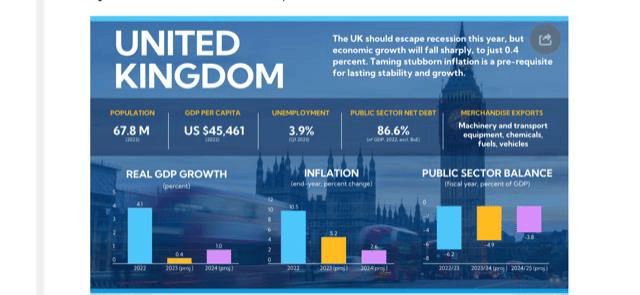
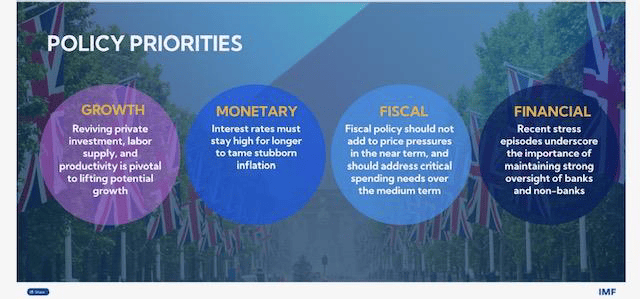
The International Monetary Fund currently have this view of the UK: –
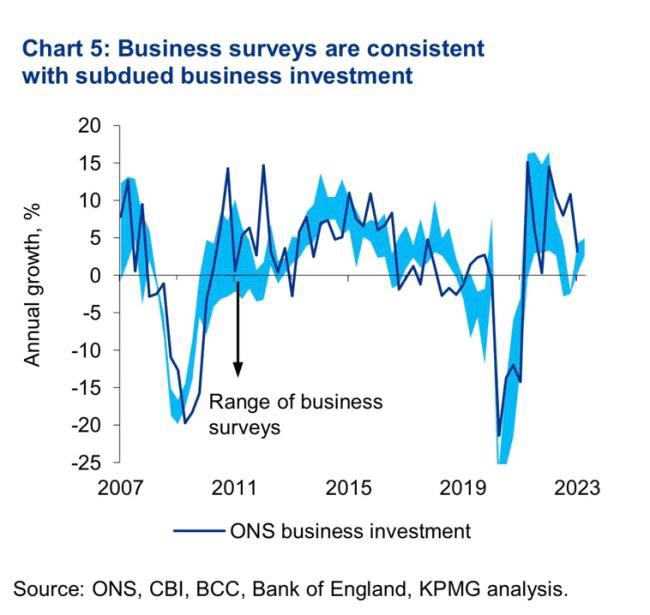
Prior to the 2008 global financial crisis, the UK had been a strong performer among the Group of Seven countries. But this momentum was lost in the middle of the last decade. By 2022, real business investment was still slightly lower than in 2016, in contrast to the 14 percent increase among other G7 economies. Labour supply, which has just reached its pre-pandemic level, has also been weaker than peers. As in other advanced economies, productivity growth has been sluggish, reflecting a slower pace of innovation and technological diffusion.
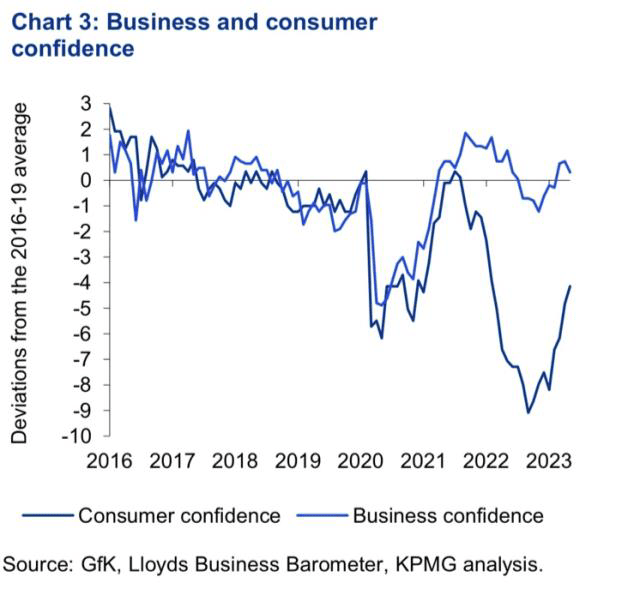
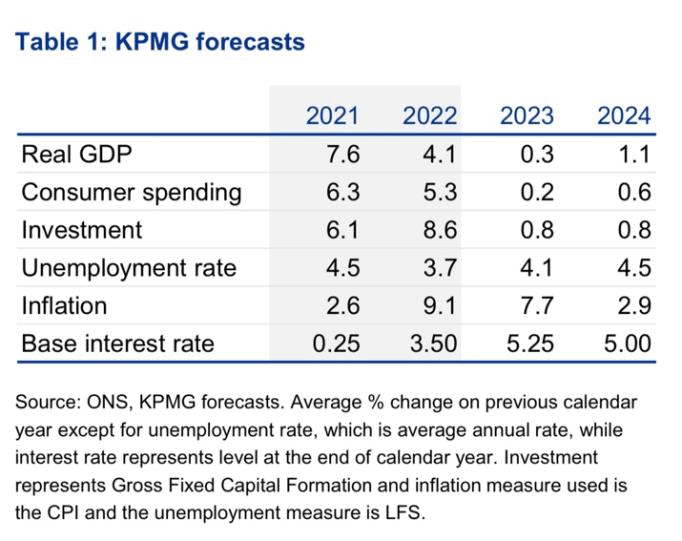
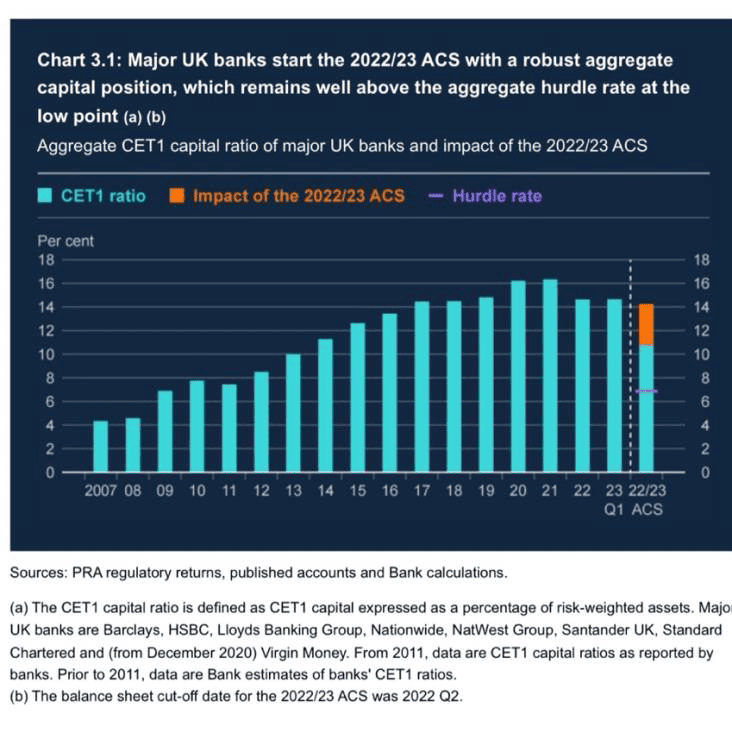
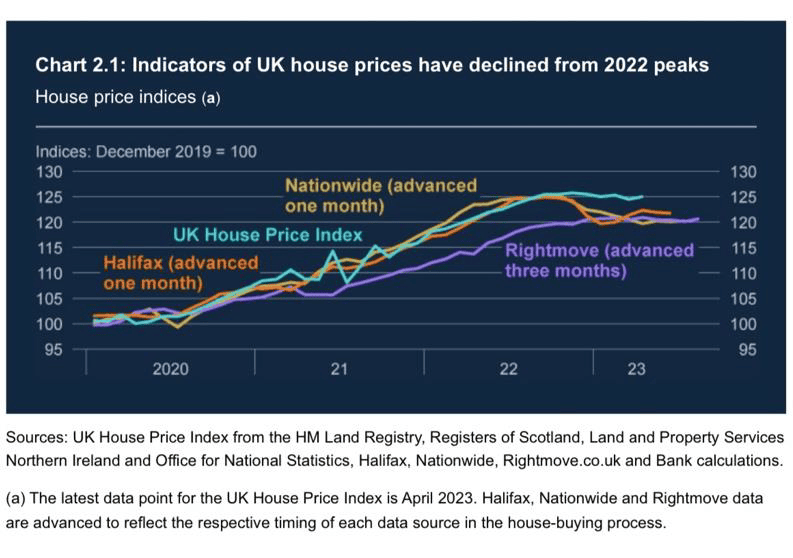
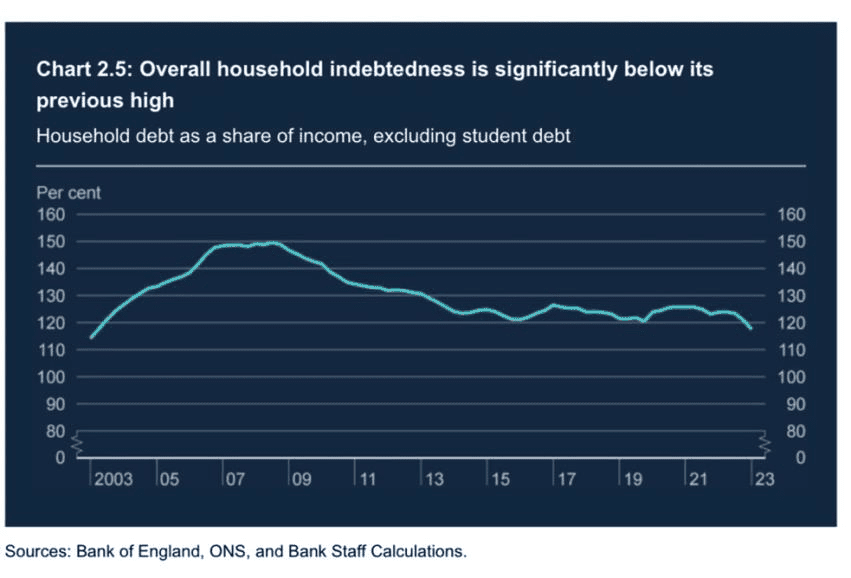
Here are the key charts: –
What do the numbers look like?
The impact of rising interest rates which have a delayed effect on economic growth means the UK economy is only expected to grow 0.8% in 2024, down from April’s 1.9% forecast.
Inflation is still expected to fall at pace in the final quarter of 2023, and the UK remains on course to avoid recession.
Overall, inflation is expected to average 7.6% this year (up from April’s 6.2% forecast), before falling to 3.4% in 2024 (up from 2.5%) and 1.7% in 2025. The Bank of England isn’t expected to reach its 2% inflation target until late 2024.
A strong start to 2023 for business investment means 1.4% growth is now expected this year, up from the 0.3% contraction forecast in April. But higher interest rates will limit businesses’ appetite to spend in 2024.
Food inflation is expected to fall to 6% by the end of the year, from just over 17% in June.
Average earnings are expected to grow 5.8% this year (up from 4.2% in April), 3.1% in 2024 and 2.6% in 2025.
With higher interest rates making mortgages more expensive, house prices are expected to stagnate in 2023, before falling by 4% in 2024.
Although 1.6 million home owners will have to renew over the next 12 months it will be a challenge as they shift from 2% to 6-8%.
The output gap is an estimate of how much spare capacity the economy has. It’s estimated at 0.1% of GDP currently. This means overall the UK has virtually no spare capacity this must change.
Currently the UK government is spending £45 billion more than its income from tax. The USA is spending $1.5 trillion more.
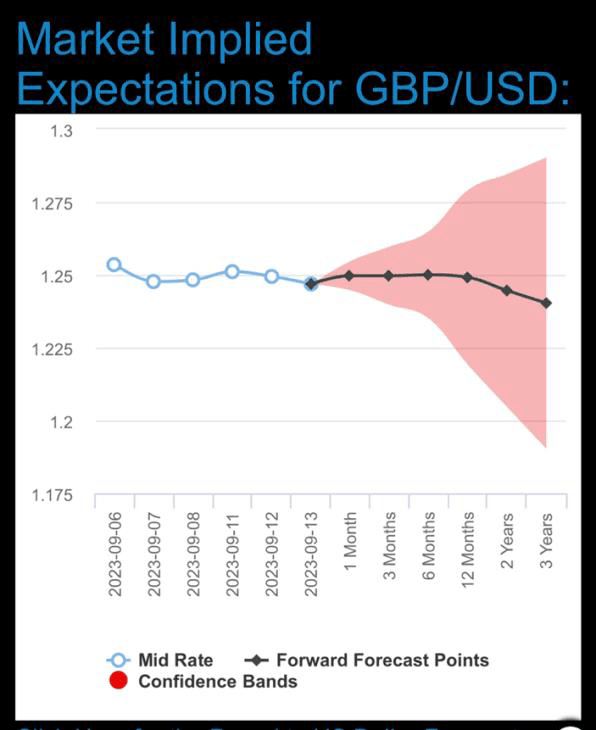
Dollar exchange rate currently at $1.25 but could move towards $1.33-35 over the next three months. This would then strongly suggest that the market think the Bank will raise base rate beyond 5.25%.
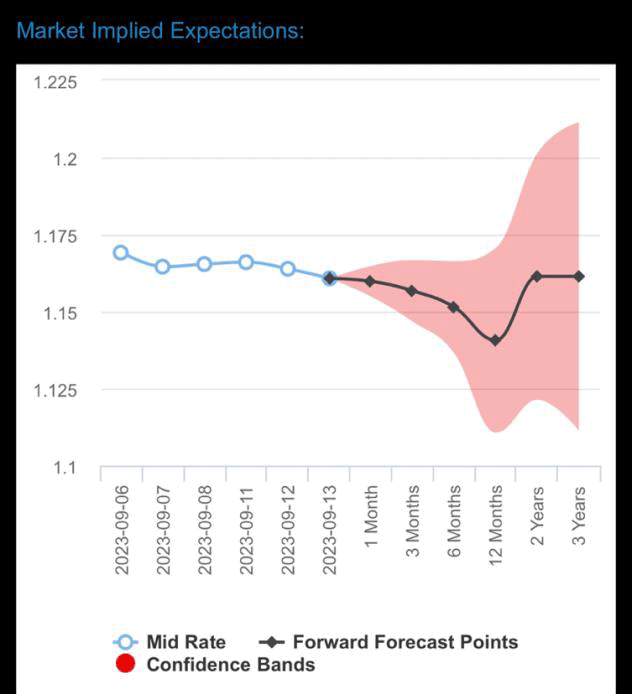
The Euro rate is 1.16 and we doubt it will go beyond 1.18 in 2023.
UK Equities
What is the outlook for UK equities are they undervalued?
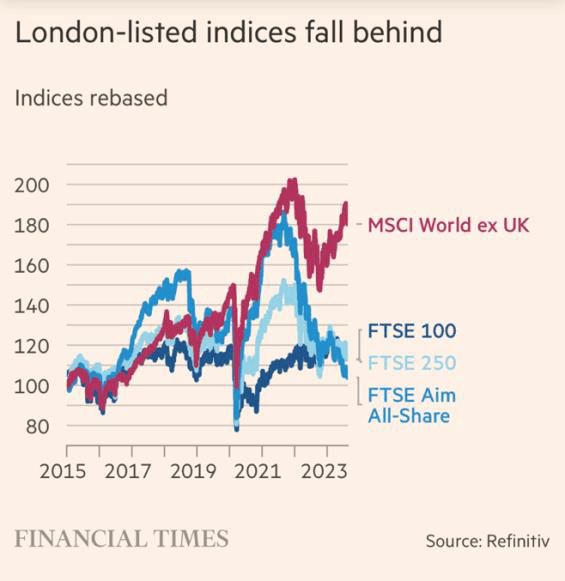
Here is what the Financial Times are saying, and this backed up by several financial institutions.
A Morgan Stanley analysis published last month found that core UK plc assets, equities and corporate bonds “are arguably the cheapest asset classes in the world”. That position is particularly remarkable given the FTSE 100 was the best-performing major global index of 2022 (by staying basically flat).
UK equities’ plunge into record discount territory versus global stocks can be traced back to the referendum in 2016. On one crude indicator, price/earnings, FTSE 350 stocks were virtually equally valued to global shares on the eve of the referendum, with both at 18.6 according to Bloomberg data. Now they’re about half the price: as of last Thursday, the FTSE 350 had a price/earnings ratio of 10, while MSCI’s World Index stood at 19.8.
So, what conclusion can we draw from these figures and forecasts? We have reviewed the outlook from one of our Uspire Network speakers the economist Roger Martin-Fagg and many of his opinions are consistent with ours.
We will just avoid a recession and the good news is that the banks remain well capitalised and can help support the governments mountain of future toxic Bounce Back and CBIL debt from zombie companies.
Interest rates will not move significantly higher with a maximum of 0.25% in the next 6 months.
Inflation will return to a level of around 3.5% by the start of 2025 when interest rates will fall to around 3%.
The predictions for GDP growth are around 1-1.3%. We agree with Roger that any growth above 1.1% will require significant investment because of the inevitable poor UK labour availability over the next ten years must be driven by AI.
House prices will fall but not collapse as will commercial property values.
The housing market will benefit from the support of family members, as Roger puts it ‘the Bank of Mum and Dad’ and there are still £125 billion of excess deposits in ‘the Bank of Mum and Dad’.
Most importantly 80% of mortgages are joint. Which is technically two incomes, both of which are likely to be going up 5-10% depending on job and location.
8.8 million are earning around £50,000pa in 2022. 9 million households have a mortgage which is just 30% of households.
During 2022 the monthly average mortgage payment was £2000 per month, and it is anticipated by the end of this year it will be around £2400 a month. The average mortgage is between £180-200k. According to the BofE statistics in 2023 only 40% of house purchase was actually debt, the rest cash. Pre-Covid the figure was closer to 50% which is a significant difference.
Labour inflation will continue at around 5% because of lack of availability and lower immigration/freedom of movement. It will not drop to 2.5-3% that others are predicting.
We may not be totally happy with the governments or Bank of England’s approach to resolving inflation, but the conservatives are attempting to hold onto votes so radical changes to stimulate the economy are unlikely. As the chief economist at the Henley centre suggested if you had just won an election, you would significantly increase taxes to reduce government debt then look to stimulate the economy via investment.
Alternatively, the government could try an alternative economic strategy that industry and retail might prefer.
Supply-side economics is a theory that postulates economic growth can be most effectively fostered by lowering taxes and decreasing regulation thus allowing free trade. According to supply-side economics, consumers will benefit from greater supplies of goods and services at lower prices, and employment will increase. Supply-side fiscal policies are designed to increase aggregate supply as opposed to aggregate demand thereby expanding output and employment while lowering prices. Such policies are of several general varieties: –
Investments in human capital, such as education, healthcare, and encouraging the transfer of technologies and business processes, to improve productivity (output per worker). Encouraging globalised free trade via containerisation is a major recent example.
Tax reduction, to provide incentives to work, invest and take risks. Lowering income tax rates and eliminating or lowering tariffs are examples of such policies.
Investments in new capital equipment and research and development (R&D), to further improve productivity. Allowing businesses to depreciate capital equipment more rapidly (e.g., over one year as opposed to 10) gives them an immediate financial incentive to invest in such equipment.
Reduction in government regulations, to encourage business formation and expansion.
However, this requires careful management and a structured communication plan with detailed monetary forecasts. Support from the Bank of England and the stock markets with a strategy agreed to underpin the pound over the short term due to the initial monetary shock of a short-term deficit and increase in borrowing.
Unfortunately, they never managed the last part correctly and created a game called surprise without a supporting financial forecast!!!!!!
Final summary
The next 18 months is very difficult to forecast accurately. Primarily because human behaviour is volatile, unpredictable and strongly influenced by what we read.
The media are very downbeat and swing with the political rhetoric and this needs to change and requires confident positive leadership.
It’s also worth remembering that the markets respond steadily to good news but over react and panic with bad news. This is why after Brexit, Trussonomics and UK inflation our equities are still undervalued.
For leaders the most important advice is don’t over leverage with current interest rates and continue to review your cost base.
However, do spend wisely and ensure that your future investment strategy is clearly targeted at reducing labour costs. The cost of people will only increase and the demand for production workers and talent must rise.
Lead with optimism and bang the productivity drum, look forward not backwards, people need to see you bounce with enthusiasm.
Sources of Information
• Ernst and Young • IMF • KPMG • Henley Business School (Dr Nikolaus Antypas) • CBI • Financial Times • Bank of England • Roger Martin-Fagg • Coutts & Co
The power of positive re-thinking
By Mark Francis – Uspire’s Director of Organisational Learning
When 16 teams have a bigger budget than us, what chance do we have to compete? It’s a logical perspective of course; it’s self-limiting too. When a team in English League 2 faced that seemingly restrictive obstacle of lower funding in 2022, we focused management and players on a set of thoughts which were high on positivity and expectation. The outcome? This season we are playing in a League higher. So does that mean that something as simple as re-framing thoughts can have a monumental impact on changing the outcomes?
This blog argues strongly: ‘Yes!’
Similarly, when we were asked by a consumer products business based in the US to help change the sales team’s behaviours, we started with an analysis of what they were thinking about in terms of: the Company, it’s performance & prospects. When we received the feedback in a passionate and largely negative flood we knew immediately that this core thinking was holding to ransome any chance of growth.
Here’s some of what we heard:-
‘We are too slow to respond’
‘We are behind the Eight ball on new products’
‘I think our prices are way too high’
‘The Customer Services team are pants’
‘We need to have a better offering’
‘The competitors do things better’
‘Where’s the investment in growth then?’
‘Nothing exciting ever happens round here!’
Consider for a moment how many of those comments could be merely fact-less personal perception? Reflect also on just how many negative consequences could derive merely from allowing this negative thinking to sit amongst your front-line teams. Inspired by a conversation with a fellow consultant Kevin Walsh#, I decided to make sure that every time I coach or train, that I would focus first on understanding and helping people’s mindset; with the right mindset, the readiness to accept some new tools and to embrace new skills becomes more possible.
Kevin Walsh and I were reflecting on the Conference we co-facilitated in Miami. The problem statement we were trying to solve was: What is the ideal sequence to enable someone to re-think a situation substantially? We agreed four steps which deliberately spell the words TEAR and TEAR. The first pronunciation to rhyme with pear, as in ‘tear up the script’. The alternative pronunciation to rhyme with smear, as in ‘A tear will flow’.
The premise is that when you change your thoughts it has a connected emotional effect. The power of the emotional response to a new thought then triggers different behaviours. Finally, new behavioural actions lead to new and consciously better results. T.E.A.R. is a fabulous model for coaching. You can begin with the results question first; next phase is the exploration of the how (actions), the motivators (emotions) and the original pre-conceived ideas (thoughts).
So, are we saying that a relentlessly positive attitude will always eventually lead to better results? ‘sometimes’, ‘not always’ and ‘it depends’. There is a prime need to re-frame the main thought. Thereafter, for the new thinking to stick, repetition, encouragement and determination to adopt the new thinking are all vital. It’s why the Tigger Effect is so useful. Tell yourself enough (with passion and a sense of fun) that the opportunities are limitless and a whole world of possibilities open up. My colleagues at Uspire call me ‘Tigger’ and in my blissful exuberance (a less Tigger-like word would be ‘ignorance’, I only see it as a compliment.
I do instinctively bring bouncing, positive energy to events which could otherwise feel mundane, routine and run-of-the-mill. The Power of positive re-thinking isn’t just intuitive for those, like me, with a relentlessly optimistic outlook. Simply start by sense checking what thought comes first in any given situation. Ask yourself two questions: what self-limiting thought is embedded in this situation? How can I re-phrase that into a wholly positive statement?
What life lessons can we learn from Tigger’s quotes? Tigger’s quotes offer valuable life lessons, including embracing optimism, facing challenges with determination, believing in oneself, and cherishing the power of love and friendship. His quotes inspire us to live life to the fullest and to find joy in even the simplest moments.
“Life is not about how fast you run or how high you climb but how well you bounce”
‘Once in a while someone amazing comes along and here I am”
“People should seriously stop expecting normal from me. We all know its not going to happen”
Does Tigger have any humorous quotes that bring laughter to the Hundred Acre Wood?Yes, Tigger’s sense of humour shines through in his quotes. Some of his humorous lines include “Why do we fall, you ask? So we can practice getting up with our bouncing skills!” and “A little laughter makes the gloomiest days bounce away!”
How to lead your business to higher profits and innovation through implementation of a deep-rooted diversity strategy
Proof points abound to show increased profit and innovation happens as a direct result of investment in an effective DE&I strategy. Despite this, it remains hard to implement.
Read Uspire’s guide to understand the most frequent sticking points which prevent DE&I initiatives rooting and develop a 12-point plan approach for success.
ByColin Wright | Uspire Chair
The topic of diversity and inclusion is a challenging subject but what is most alarming about this issue when you look back at its chequered history and ask yourself this simple question. Why does it take high profile events, scandal, unnecessary fatalities, or celebrity led campaigns to just do the right thing and follow a true non-judgemental moral compass?
To consider the way forward and promote the development of the right culture of diversity and inclusion in the workplace its only appropriate to look back at some of the challenges that race, sexual orientation and gender have faced over the years. Undoubtedly, we are making progress, but we are still surprised even today by some of the headlines we read or observations we make at work or in society.
One of the least acknowledged fights for equality and inclusion was the children’s crusade in 1963, Birmingham, Alabama. They overcame the cultural fear that was embedded in Southern society since slavery. Thousands of children gathered at the Baptist church in place of their parents, who, under Alabama law and social oppression, would be subject to severe penalties like loss of job and imprisonment if they protested against the racist and unjust segregation laws of the State. Many children left their schools ,some as young as eight years old, to join the march. In response the commissioner for public safety ordered police to use dogs, high pressure fire hoses and batons to break up the crowd of children. This atrocity created the publicity that broke the barrier to equality and social justice without realising at the time children like Cynthia Levinson became the pivotal point that caused changes to take place in society, internationally people were observing the treatment of these children and demanding change.
JFK then in its wake established new federal civil rights legislation explaining that it was not a political issue, but a moral issue and he outlawed racial segregation.
Now let me take you back to a personal experience from the late eighties and working in the confectionary industry. At the tender age of 26, appointed the site director for a medium sized enterprise which gave me the responsibility for all parts of the business except sales, marketing, and finance. Having grown up in a mixed-race comprehensive school, enjoying a great cross section of friends, this was a normal environment. Now in the artisan world of sugar confectionary without me knowing existed an unwritten code. This was a male dominated environment, and a true craft. Large bowls of boiling sugar were flavoured, coloured and tempered on cooking tables by hand. Men made the confectionary and women operated the wrapping machines, and the wage structure was heavily weighted towards the male dominated jobs. We also had only one black person employed by the company a lovely man called Leroy whose job it was to take the colours and flavours to the production lines for the master confectioners to mix into the boiling sugars.
During my early months I asked the obvious question why had no women ever applied for the master confectioner jobs and if Leroy had ever been trained to become a confectioner. Not surprisingly the response was “no it’s not womens’ work because the sugar mass is too heavy for them and they will burn their soft hands”. Apparently, Leroy was “not very bright and could not be trained to the required standard”. So, at 26 going on 27 what do you do when faced with such an obviously inappropriate but engrained management response? Well hopefully and thanks to my upbringing I followed my values.
Firstly, with HR we introduced a women’s master sugar confectionary programme. Unfortunately, we had no applicants in the first 3 months. However, several months later following encouragement a group of three women applied for the programme. I know and suspect they got considerable abuse from male colleagues and only one, Joyce, survived the programme because she was a robust character. The whole initiative was surrounded by union officials threatening work to rule, apparently it was a divisive strategy by me to lower the wages of men rather than allowing women to earn the same wage!
I moved on after a couple of years to a new opportunity but when I spoke to old colleagues from the business the department then had four female master confectioners. As for Leroy this was a less successful outcome in my eyes. Fortunately, I was able to bring about change when the production team were overwhelmed by the sales volumes. Our pipeline with key customers had taken off and was challenging the capacity and resource capability. The team were under pressure and we brainstormed how to accelerate the training programme and get more resource available for weekend overtime production. I suggested everyone in ancillary roles who were familiar with the working environment and health and safety conditions. Several people were mentioned as candidates but not Leroy. In the end I proposed him and insisted that he be given a chance. It turned out that Leroy who had worked for years carrying these flavours and colours to the line was a natural he had just learnt from years of observation what to do. However, two things happened that I regret as soon as volumes returned to normal Leroy was never again asked to work on the production lines. I also discovered that he had not even been paid the increased wage when working on the lines. Six months later Leroy left the business and moved his family to Alfreton where he had got a job working at Thorntons. I cannot help thinking that he was subjected to unpleasant treatment and seen as “bosses’ favourite” which made life increasingly difficult for him.
The history of great sacrifices and bravery should always be referenced when dealing with the challenges of diversity and inclusion.
Nelson Mandela’s fight for democracy and inclusion will never be forgotten. He stood against the National Party white only government and fought against the racial segregation policy introduced in the 1940’s. Serving 27 years in prison knowing that his captors had a deep-rooted racial bias his humility and forgiveness held no boundaries. He is quite rightly seen as an icon for social justice. He received over 250 honours and the Nobel Peace Prize.
Some of his quotes were so inspirational.
“Difficulties break some people but make others. No axe is sharp enough to cut the soul of a sinner who keeps on trying only if you are armed with hope and belief can you rise above and be liberated”.
“When people are determined they can overcome anything, and human goodness is a flame that can be hidden but never extinguished”.
“What counts in life is not the mere fact that we have lived. It is what difference we have made to the lives of others that will determine the significance of the life we lead”.
Could you have a better vision for a corporate diversity and inclusion strategy?
Despite DE&I having been firmly on the corporate agenda for a decade now, stats are still disappointing.
In the US, Google’s employees are 69% male overall with only 2% Black, and 4% Latino.
The Equality Group FTSE 100 CEO Diversity Data report carried out in July 2023 found there are more CEOs named Simon and Andrew than the total number of female FTSE 100 CEOs. Meanwhile, there are almost as many Simons as there are companies run by ethnic minority CEOs.
Growing up in the 70’s and 80’s I can remember the unpleasant rhetoric surrounding the likes of Billy Jean King and Martina Navratilova which was disgraceful. I recently thoroughly enjoyed the film “Battle of the Sexes”. She was a remarkable woman who used her celebrity status to promote diversity and equality in a constructive and determined manner. The catalyst for addressing the pay gap and open recognition of gender diversity. She stated that “women get attention only when they step into the men’s arena and that’s sad” and boldly aired this opinion at a time less open than today which was “Everyone has people in their lives that are gay, lesbian, transgender or bisexual. They may not want to admit it, but I guarantee they know somebody”.
BJK constantly battled with the bias opinion of gender meritocracy back in the 70’s. Even today that issue is contested. A Fortune 1000 survey in 2009 asked organisations if they have an embedded meritocracy system where people are rewarded, hired, and promoted based on their abilities. All the board members of those companies said yes. A follow up survey with employees from those companies in 2010 where half of the population is female found that only 15% of all executive positions were held by women.
When women were asked why they thought this was the case, they responded that it was due to lack of opportunities for promotion and respect. In 2017, 45 top female presenters wrote to the BBC director to complain about the gender pay gap.
Notably not one man had supported them or signed the letter because “it was a female issue”. So, it was left for the women to fight the battle without any participation from men who were benefiting from pay disparity.
Let’s consider the definitions of these two important terms.
Diversity
This is the broad definition of how we all differ, and it should include everyone. Not only the obvious visible differences like, nationality, ethnicity, age gender and noticeable disabilities, but also less obvious differences. These include religion, sexual orientation, heritage, social class and unseen disabilities, the way we think, education and family status. It needs to embrace not only the working environment but also recognise the international framework and where your employees choose to call home.
Inclusion
For leaders, this harnesses humility and recognition. It’s about celebrating differences and promoting a culture in the workplace where these differences can thrive. Values are fundamental, everyone should feel respected, engaged, supported, listened to, encouraged, and be given the opportunity to develop their skills to the best of their ability.
Over the past decade we have experienced a more proactive approach in organisations, the evidence of diversity and inclusion strategies emerging across the business world is long overdue and the quality is significantly improving.
In the words of Verna Myers, “Diversity is being invited to the party; inclusion is being asked to dance”.
Believe it or not diversity in the workplace was being discussed and debated back in the 1940’s in fact in America President Truman issued the first order to desegregate the army. In the 1960’s the topic is more front of mind and organisations are starting to respond to the pressure of civil rights movement.
The main barrier to development even right up to 2010 was being able to understand the real value of such initiatives.
So does diversity add commercial value?
Well, McKinsey’s 2014 report Diversity Matters was one of the first to provide solid commercial evidence to support the undeniable “moral initiative” that leaders should embrace.
It showed that highly diverse companies are 35% more likely to enjoy above industry average returns than their less diverse competitors. Should that really be a surprise because in the same report it identified that women and minority groups make the majority of consumer decisions, therefore logic suggests that companies that better represent these groups will be better at understanding the customer and therefore growing their business.
Other research by Boston Consulting Group indicates that more culturally diverse and inclusive companies have greater creativity and innovation characteristics. Diversity jolts us into a more cognitive state of action because it creates an environment of more alternative and unexpected points of view. The report determined that more diverse management teams have 19% higher revenues due to innovation.
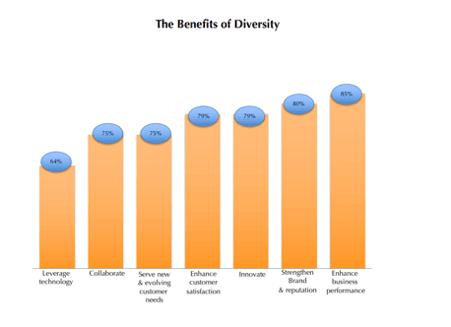
In a survey by PWC interviewing 410 CEOs from 62 different countries the commercial argument could not be more powerful.
The chart below shows that in the opinions of these executives a strategy to promote diversity and inclusion would potentially improve company performance by between 64% and 85% on these seven measures.
So, if we have firmly established the moral requirement and now the financial impact, how can we deliver a more effective DE&I strategy? Where most organisations go wrong is that they misunderstand the complexity of the programme itself and the difficulty of overcoming the challenges of unconscious bias. Let’s consider why DE&I strategies fail to achieve the progress that companies normally expect in the commercial world.
1. It requires an empathetic leadership style. 2. A vision statement from the top is just not enough. It needs the why, what, how and when. 3. The business or team fail to create a “sense of belonging” to the programme. 4. It is not aligned to the values or the brand. 5. Establishing quotas does not “automate” the inclusion and diversity process. 6. One off training is not the answer it’s an ongoing process of change. 7. It must be about joy, freedom and making connections. It comes from the heart not only the mind. 8. It’s not about “fit” and “process” but about focusing on help and support. 9. Teams hold neither the courage nor authority to deal with resistance. 10. The programme becomes devalued by other business priorities.
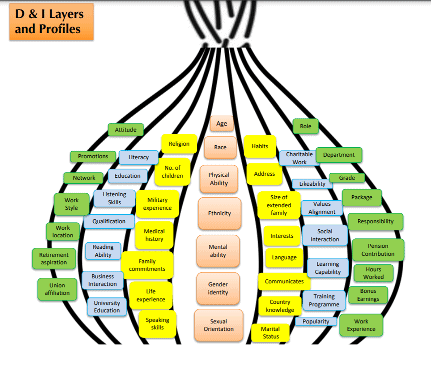
To understand the complexity of the task let’s consider what we refer to at Uspire as the “diversity and inclusion onion”.
The layers represented in this chart help leaders to understand the detail required and the triggers that can disrupt the effectiveness of your programme. From defining the central core all the outer layers represent the awareness required to ensure that the risks of discrimination and inequality can be avoided.
The challenges of unconscious bias
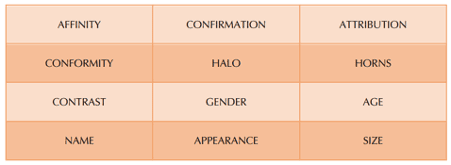
This is also often referred to as implicit bias and it represents the underlying attitudes and stereotypes that everyone unconsciously attributes to another person or group of people. It fundamentally without realising, affects how they understand and engage with a person in that group. An example would be talking loudly without realising to an old person because you subconsciously assume, they might be slightly deaf. We can identify 12 types of unconscious bias.
Bias is an ever present characteristic and almost impossible to avoid. It is an inbuilt prejudice that can hold you back. It can be harmless because you grew up supporting a certain sports team and you think they are the best even though deep down you know they are not very good.
But unconscious bias can cause significant issues when developing a DE&I strategy. Here is a simple but highly impactful global example. Most people are right-handed and even today designers predominantly create products that are awkward for left-handed people like tape measures and can openers.
Things to consider when formulating your D & I programme.
Uspire recommend using this twelve point checklist for an effective DE&I implementation.
1. Gather information to understand in detail what you are dealing with. 2. Document the micro-triggers that can derail your progress use the “D & I onion”. 3. Now prepare your vision for the future and use language that represents to your audience that you embrace diversity and inclusivity. 4. Challenge and heighten the awareness of unconscious bias. 5. Educate the leadership team. What will be their needs and barriers? 6. Examine the company communication and social media feeds. 7. Implement a programme of diversity training to broaden understanding 8. Remove cultural and potential values conflict, examine the historical company foundations and cultural architecture. 9. Establish the measures and recruitment criteria that will guide the programme. 10. Promote a culture of mentorship where diversity can be coached. 11. Build in feedback mechanisms and encourage open communication. 12. Make the programme fun, embrace diversity by holding cultural events.
As a commercial leader you are on a pathway to deliver success in both human and financial capital. DE&I adds value on all levels and continues the progress we are making in society throughout the world.
Many have suffered to challenge and promote a new and inclusive way of living. One of my old mentors, an athletics coach who helped the Team GB 4 x 400 relay team to Olympic gold, gave me this advice. “We all get a chance to carry the baton through life and when we grip it tightly in our palms, we must focus on handing it firmly and smoothly onto the next person so that they can continue the race”. He went on to be one of the inspirations around the Paralympic movement and was one of the first black sprint coaches.
We began with the inspiration of people who have campaigned and suffered for diversity and inclusion so let’s end this blog with their wisdom.
“My parents especially my father discussed the question of my brothers education as a matter of real importance. My education and that of my sister were scarcely discussed at all. Since then I have made speeches urging women to get their voices heard and adopt methods of rebellion such as have been adopted by men in every revolution.” – Emmeline Pankhurst
“An individual has not started living until they can rise above the narrow confines of their individualistic concerns to the broader concerns of all humanity.” – Martin Luther King
“It is great that women are coming out to demand rights, they are marching. My message is for them to keep standing up for those who are oppressed, the poor, the disenfranchised, to never be scared of those in power and give into their intimidation. We campaign for equality and pray for change.” – Veeru Kholi – Present day female activist born into Pakistani Bondage.
For further inspiration try the following books :-
The Memo by Minda Harts
Blindspot by Mahzarin R Banaji
This Chair Rocks by Ashton Applewhite
For those of you with young children or for your own evaluation :-
All Are Welcome by Alexandra Penfold
A is for Activist by Innosanto Nagara
Lovely by Jess Hong
Separate is Never Equal by Sylvia Mendez
Let the Children March by Monica Clark-Robinson
The Agility Code: Event Review
Gathering with anticipation, and more than a little excitement for what lay ahead, senior leaders from across the country joined us for our live leadership event on 19th October in the charming and historic Mary Ward House in central London – all staring wide-eyed and mesmerised by the powerful story from out Headline Speaker, Bonita Norris.
Because Uspire events are not typically formulaic, with droning speakers staring at their shoes, we always challenge our guests with the day’s a key provocation and everything they see, hear, and do is channelled back to that.
Jonathan Brough – Uspire MD
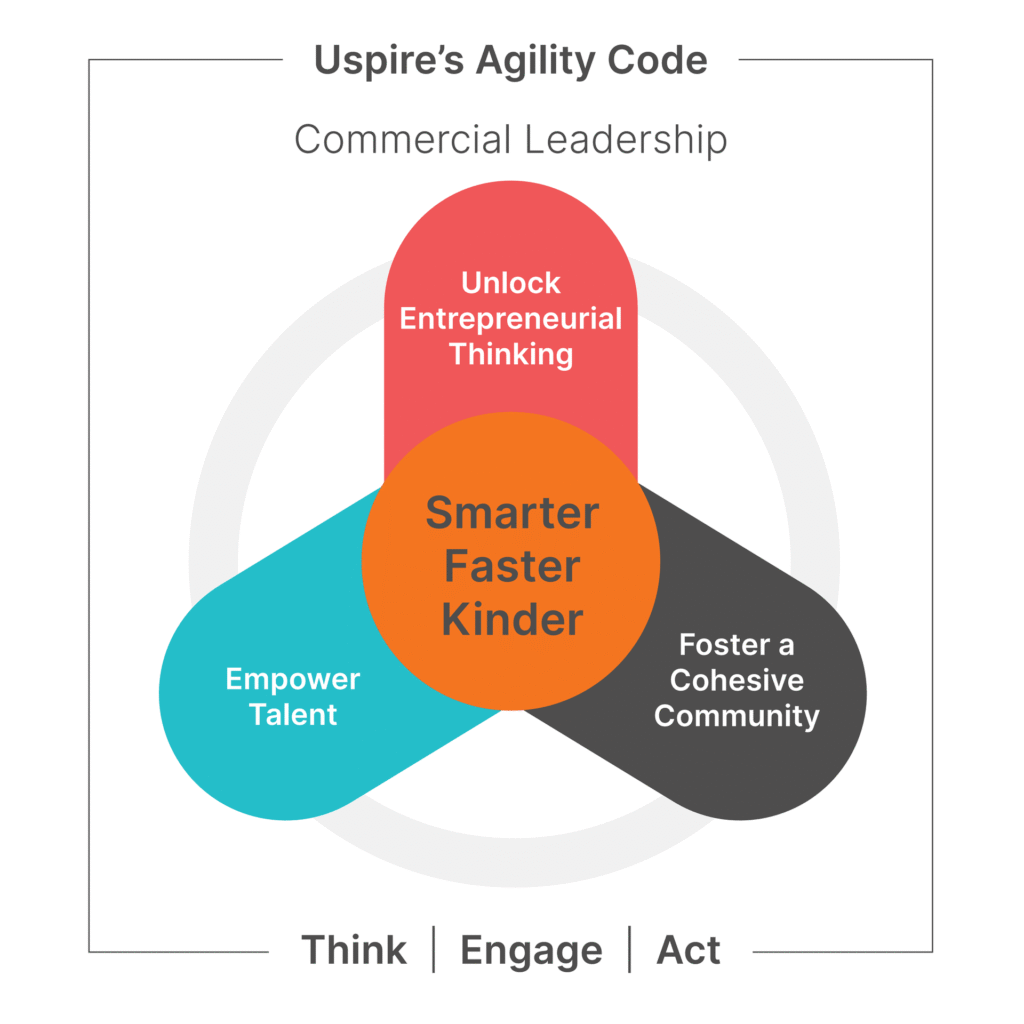
So with his trademark enthusiasm JB, Uspire’s MD, challenged everyone in the room to think how they, as leaders, can become more agile using the core values of the Agility Code.
The Agility Code was created to encourage organisations to empower talent, to release their latent energy and potential and channel it to kick-start dramatic change. And Bonita’s achievement certainly demonstrates how much can be achieved by unlocking an entrepreneurial spirit: trying new things, taking new risks and thinking way outside the box.
Bonita Norris – 19th October ’22
A non-climber, who, with no climbing experience, little money, and only her passion to succeed and ability to adapt, stood on the summit of Everest at the age of 22. The youngest British woman at the time to have ever done so, and now the perfect embodiment of the Uspire Agility Code.
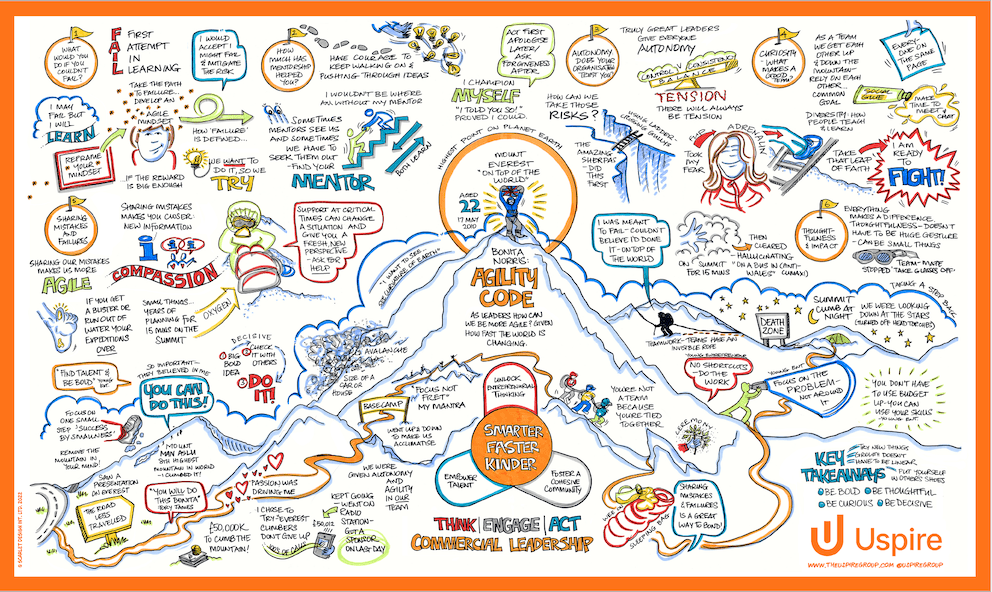
Bonita’s story is fascinating and to really learn from it you need to hear it spoken from her heart, and let her take you on her journey from wet Welsh mountain slopes to the rarified air at the top of the world.
But to get a birds-eye view then the fantastically creative Fran O’Hara captured the key moments from Bonita’s talk as she explained how she confronted her fears and limitations to realise her dreams.
After a fabulous networking lunch we got stuck into the afternoon session, putting our new-found agility to use on developing a pitching video for our new (fictitious) company Sabbatico.
So JB set the challenge, and each table was sent off to work out their ideas for pitching the idea of Sabbatico to the Zillennial Jury, our panel of Zillennial (Millennials and Generation Z) reviewers, the only condition was that the pitch needed to be a 60 sec video!
So, after 30 minutes of furious activity we had 11 video pitches, presented to and critiqued by our Zillennial Jury.
As usual, the awesome Fran O’Hara was on hand to capture proceedings and convert into this incredible interactive map.
Simply select the table number to watch their video pitch.
The day was dynamic, interactive, provocative and energising, and we asked a couple of guests to share their thoughts on their experience.
Rhys Howells, Managing Director, Eteach:
Oliver Gosejacob, Global Account Director, parcIT, Cologne, Germany:
The Agility Code is just one of a number of events delivered by The Uspire Group, from in-person interactive forums, to our live online leadership debates.
To hear about upcoming events register here, or if you would like to speak with us about how we may support your leadership journey, then contact us on team@theuspiregroup.com.
Manage Consent
We use cookies to provide you with content based on your interests. They also help us understand how you use our website and personalise your experience. You can accept all cookies, reject all non-essential cookies, or customise your preferences.
Strictly necessary
Always active
These cookies are essential for the website to function. They enable things like submitting an enquiry, booking a discovery session and downloading our book. We can't turn these off.
Preferences
The technical storage or access is necessary for the legitimate purpose of storing preferences that are not requested by the subscriber or user.
Statistics
The technical storage or access that is used exclusively for statistical purposes.The technical storage or access that is used exclusively for anonymous statistical purposes. Without a subpoena, voluntary compliance on the part of your Internet Service Provider, or additional records from a third party, information stored or retrieved for this purpose alone cannot usually be used to identify you.
Marketing
Technical storage or access used to understand how visitors interact with our website. This includes sharing statistical data with third-party services like Google Analytics to help us improve our site.